Wednesday, May 19, 2010

BPA drops out of Oregon transmission line to Idaho

by Rocky Barker 5/18/2010 http://voices.idahostatesman.com/2010/05/18/rockybarker/bpa_drops_out_oregon_transmission_line_idaho#ixzz0oPa7BDsk

The Bonneville Power Administration has told Idaho Power it doesn’t plan to participate in the proposed Boardman (Ore.) to Hemingway transmission project.

BPA had been looking at joining Idaho Power and perhaps Pacificorp in the line that will connect the Idaho utility near Melba with BPA-control federal hydropower near the Columbia River and wind energy resources in the Columbia Gorge. The line also would allow Idaho Power to sell its power in the winter to BPA, which is peaking at that time of the year. Idaho Power peaks in the summer during the height of the irrigation season.

But BPA decided to stick with its current deal, paying Idaho Power to “wheel” its power through its service area to electrical coops and the Idaho Falls city electrical system it serves in southern and eastern Idaho and Wyoming.

The decision had nothing to do with the controversy that has erupted in Oregon over the proposed power line, BPA spokesman Doug Johnson said.

BPA has not completely ruled out joining in and is asking its coop and utility customers for comments on its decision.

Meanwhile, Idaho Power has moved its proposed route away from the Oregon Trail Interpretive Center near Baker in response to concerns raised by residents there. But the new route still can be seen from the center and residents urged Idaho Power to consider another route that runs through a sage grouse lek area, where the birds mate, which state officials will not approve.

In other transmission news, Rocky Mountain Power energized its first portion of the Gateway transmission line project that it is building across Idaho. The first leg is in Utah according to the Idaho State Journal.

Monday, May 17, 2010

Payette County paves way for proposed nuclear plant

http://www.messenger-index.com/news/article_5c8d950e-57a3-11df-af6d-001cc4c002e0.html

May 5, 2010 - In a unanimous decision last week, Payette County commissioners approved a change to the county's comprehensive plan that represented a major hurdle for Alternate Energy Holdings, Inc.'s efforts to build a nuclear plant there. The commissioners' action raises some concerns for Emmett residents.

"This important decision sets the stage for the final step for approval of a large advanced nuclear power plant and also gives a strong indication of support by county leaders resulting in a win-win for AEHI stakeholders including the many benefits to the county, state and region for low-cost, clean, reliable power, not to mention rewarding our investors for their support," AEHI CEO Don Gillispie said.

The change creates a footprint for industrial uses in an area once designated for the sole purpose of agriculture. More specifically, the wording will allow for an industrial complex on a 5,000-acre parcel near Big Willow Road and Stone Quarry Road, just a few miles from New Plymouth, as long as that industrial purpose involves a nuclear power plant.

"This vote affirms the will of the majority of residents of Payette County who have told us and the commissioners they want a nuclear power plant in their community. They want the jobs and the financial stability for the towns in which they live - something our plant can and will create," Gillispie said.

Idaho Downwinders Director Tona Henderson, of Emmett, is concerned on two fronts:
"What will they do with the waste from the nuclear plant? There are 103 nuclear plants in operation (in America) right now," Henderson said. Most of these locations have been storing the waste on-site, some for as many as 30 years. There are reports that some containers have begun to leak, Henderson said. "I'm concerned the waste from the Payette site would be stored on site."

Henderson's second concern has to do with the geography of the area. About 40 years ago, the Idaho Geological Survey did a study of oil and gas reserves in southwest Idaho, according to a book Henderson has read.

Idaho Power plan angers residents

by Chris Collins 5/7/2010 http://www.bakercityherald.com/Local-News/Idaho-Power-plan-angers-residents

Baker County residents again came away disappointed after a three-hour session in which Idaho Power Co. officials laid out plans for construction of a 500-kilovolt transmission line from Boardman to Hemingway, Idaho.

Idaho Power announced last month that its preferred route will travel about a mile east of the Oregon Trail Interpretive Center. Earlier reports set the distance at a half-mile from the interpretive center.

Still, members of the Baker County group Move Idaho Power and other residents of Baker and Union counties told company officials they are not happy with the plan.

“You want to pass right through, pick up all you can that’s worth money and drive on down the road,” she said. We’re not happy about that.”

The Baker County session was one of a series of Project Advisory Team meetings scheduled by Idaho Power throughout the region to present the proposed route and to outline future steps in the process. The company next will submit its plan to the Bureau of Land Management to begin the National Environmental Policy Act (NEPA) process.

The advisory groups were established last spring after Idaho Power took its original plan, which was to build the line west of the interpretive center and into the view of Baker Valley, off the table because of community opposition. At that time, Idaho Power agreed to start fresh with Boardman and Hemingway as the only two points on the siting map.

During the past year, the company considered about 450 comments from members of the advisory groups in making its routing decision, Kent McCarthy, Idaho Power Co.’s community advisory process leader, told the Baker County audience.

The route was moved to accommodate Baker County concerns about its proximity to the interpretive center and its placement to the west of the center, McCarthy said. The newly proposed route crosses Highway 86 about a third of a mile east of the center’s entryway and angles north to within about a mile of the center, McCarthy said.

The company is required by the Oregon Department of Fish and Wildlife to maintain a two-mile buffer around identified sage grouse leks, he said. That prevents Idaho Power from moving the transmission line farther from the center.

“As of January, ODFW reclassified an old sage grouse lek and made it impossible,” McCarthy said. “We’d love to go another three miles.”

Timm told McCarthy to try harder to persuade ODFW of the need to move the proposed route.

“You argue with us and put it where we don’t want it,” she said. “Why don’t you argue with them for a while.”

Timm also suggested perhaps county residents could oppose Idaho Power Co.’s relicensing application for its operations on the Hells Canyon dams when it is next up for renewal if the company refuses to compromise further on the proposed route.

“There’s a thousand other places you could probably go — pick one,” Timm told the company representatives to the applause of many in the audience.

“And on public land,” came a shout from the crowd.

Jim Eidson agreed with Peyron and Timm about the company’s apparent lack of regard for input it has received from Baker County residents over the past year.

“We are pretty much asking you not to bring it to Baker County,” Eidson said. “It looks like this is the meeting to tell us what you’ve decided to do. You could have saved us 10 to 15 meetings by telling us a long time ago.”

David Angell, Idaho Power’s manager of delivery planning, reminded the audience that Idaho Power has no choice but to comply with environmental restrictions.

“It doesn’t mean that we stop there,” he said. “What we can do is work going forward to adjust the route to getting as close as we can to something doable. Sage grouse leks and other habitat ... those are things we would have to work with the agencies on.”

And Idaho Power will meet with every landowner affected by the proposal, before any construction begins, McCarthy told the crowd. Idaho Power will seek a 250-foot right of way to property crossed by the transmission line and proposes a lease of a minimum of 40 years and possibly twice that with property owners, Angell said.

Baker County Commission Chair Fred Warner Jr. said during Wednesday’s meeting that the county would receive additional property taxes of about $600,000 from the Idaho Power project.

In an interview Thursday, Warner said about $250,000 to $260,000 would go to the county budget and the remainder would be divided among the county’s special districts for services such as fire protection and libraries, he said.

Warner said he hopes the county can persuade ODFW to allow Idaho Power to move the line farther from the Interpretive Center.

“It’s too close,” Warner said. “From three miles it could be visible, but not very visible.”

Warner said he hopes to employ several strategies to achieve the best outcome for Baker County and its residents.

“Can it be done? I don’t know. But we’re sure gonna try,” he said.

Warner said he also hopes to ensure that Idaho Power Co. makes annual lease payments to landowners whose property is affected rather than a lump-sum payment. He has proposed that the company hire an ombudsman to work for Baker County to represent the landowners in lease negotiations.

“I don’t particularly want (the transmission line) in Baker County,” he said. “But our goal is the least impact on the viewshed and the people it affects.

“We’re just trying to make the best of what’s probably not a very good situation,” he said.

Tuesday, May 4, 2010

Nobody Talks About the Land

'This is an excellent and moving article on how many of us view our land. Oregon's land use laws are unique in the world, and I believe our laws originated from this type of thought. It is unfortunate that this "long distance energy swapping for profit" mindset is intruding on our private land...' Nancy Peyron, Baker City

http://calhounpowerline.wordpress.com/nobody-talks-about-the-land/

As part of my education about high voltage power lines, I have watched a couple of Webcasts of hearings and panel discussions at the Federal Energy Regulatory Commission and the Department of Energy.

I have watched these discussions, and I’ve heard lots of talk about the environment, green this and green that, “renewables” (one of those ugly nouns stolen from an adjective) and lots of other Washington jargon. In all of these discussions, I have not once heard anyone talk about the land. Everyone talks about transmission lines as though they were just wires. They refer to coal as just another fuel without any mention of where that coal comes from or what it really costs to mine it.

I live on a farm in Calhoun County, West Virginia. When I talk with my neighbors about deer hunting, building fence or hauling hay, they never refer to my land or my property, they say, “Those deer ran through you.” Those of you who live in a city or suburbs may not understand the world view that this way of thinking reflects. It is, however, very real where I live.

We see our land as part of “us.” This is not some kind of modern “eco-awareness.” It is a cultural view of the world that connects back through time to the peasant cultures of Europe and the culture of people native to North America. Those cultures still resonate strongly in rural West Virginia, as they do in other parts of our country.

What does this have to do with power lines?

The PATH power line will take more than 6000 acres of West Virginia land out of productive use by living, breathing West Virginia families.

Now think of the people who own, live on and work that land. Each of those families have lived with that land, some for all their lives. Living with a piece of land is a privilege. It is a relationship, just like a relationship with a friend or someone in your family.

Living with a piece of land means that you shape that piece of land to meet the needs of your family and perhaps to make a little money. You build fence, perhaps some buildings, maybe a pond. You build and restore your soil with manures, compost, fertilizer and lime. You raise a garden and do a little hunting or trapping. You manage your own animals and their pasture.

Much of your life’s work and much of your play grows out of this land. It becomes a part of you. As you put more of your energy into the land and it gives back food, your body literally becomes part of the land and the land becomes a part of you.

Living with a piece of land also involves lots of compromises. You make mistakes. Sometimes you do damage. Because our farms are small, and none of us has lots of money, the damage that any of us can do to our land is pretty small. It can almost always be fixed given a little work and time to heal. We know the scale of our compromises, and we take responsibility for them every day.

A 138 KV power line crosses my holler. It is 5 lines suspended from 80-foot wooden towers. The right of way takes up less than 100 feet and the land owner who originally gave Allegheny Power the right of way had the wisdom to ban herbicide spraying on this section of the line.

This power line is big, but it is small enough for us to live with. It is a compromise we all accept. This line runs from a West Virginia power plant to Spencer, the neighboring county’s county seat, from which our own power comes. We know that we and our fellow Calhoun Countians benefit from this line, so we live with it.

I didn’t hear anyone in Washington at these national energy conferences talking about compromise. Those of us who live with the land understand compromise, because we do that all the time on our farms. All I heard was sneering talk about how land owners were in the way of progress and something called “the national interest.”

For the folks at FERC and DOE, money should be enough. Pay them for their rights of way, and they should shut up and go away. And live with power companies controlling a large strip of land right through the middle of their farms. Well, it’s a little more complicated than that.

If you want to come across me with your big power lines, you have to start by talking about the land. If you don’t understand that, you’re in for a fight.

Friday, April 30, 2010

Continuing process

Click for larger view

Download detailed section maps at the following website: http://www.boardmantohemingway.com/idaho_power_CAP_Maps.aspx

Idaho Power moves toward next step in line location By LARRY MEYER 4/10/2010

ONTARIO — With the community advisory team process coming to a close, and Idaho Power having chosen a route to the liking of citizens and local officials in Oregon and Idaho, the process of the siting the company’s 500Kv line between northeast Oregon to southwest Idaho, is going back to state and federal agencies for route approval.

One more change was made to the proposed route endorsed at the previous team meeting — a swing to the east after the line would go west of Brogan, to bring it closer to Huntington for the protection of a sage grouse breeding habitat.

The community advisory process has been ongoing since last year, when Idaho Power faced stiff opposition in Malheur County and other counties, in Oregon and Idaho, for its initial proposed routes.

Malheur County residents primarily opposed the route over prime farming areas in the Nyssa and Adrian areas, and between Ontario and Vale, asking Idaho Power to move the line away from exclusive farm use land. In its review of proposed routes, Idaho Power officials concluded it could not get state approval for siting the line over exclusive farm use ground.

As reported, the proposed line skirts most of the farm land in Owyhee County in Idaho and Malheur County in Oregon, following the existing Pacific Power and Light line west of Owyhee Reservoir. The line cuts north in the vicinity of Vines Hill and swings just west of Brogan before going into Baker County.


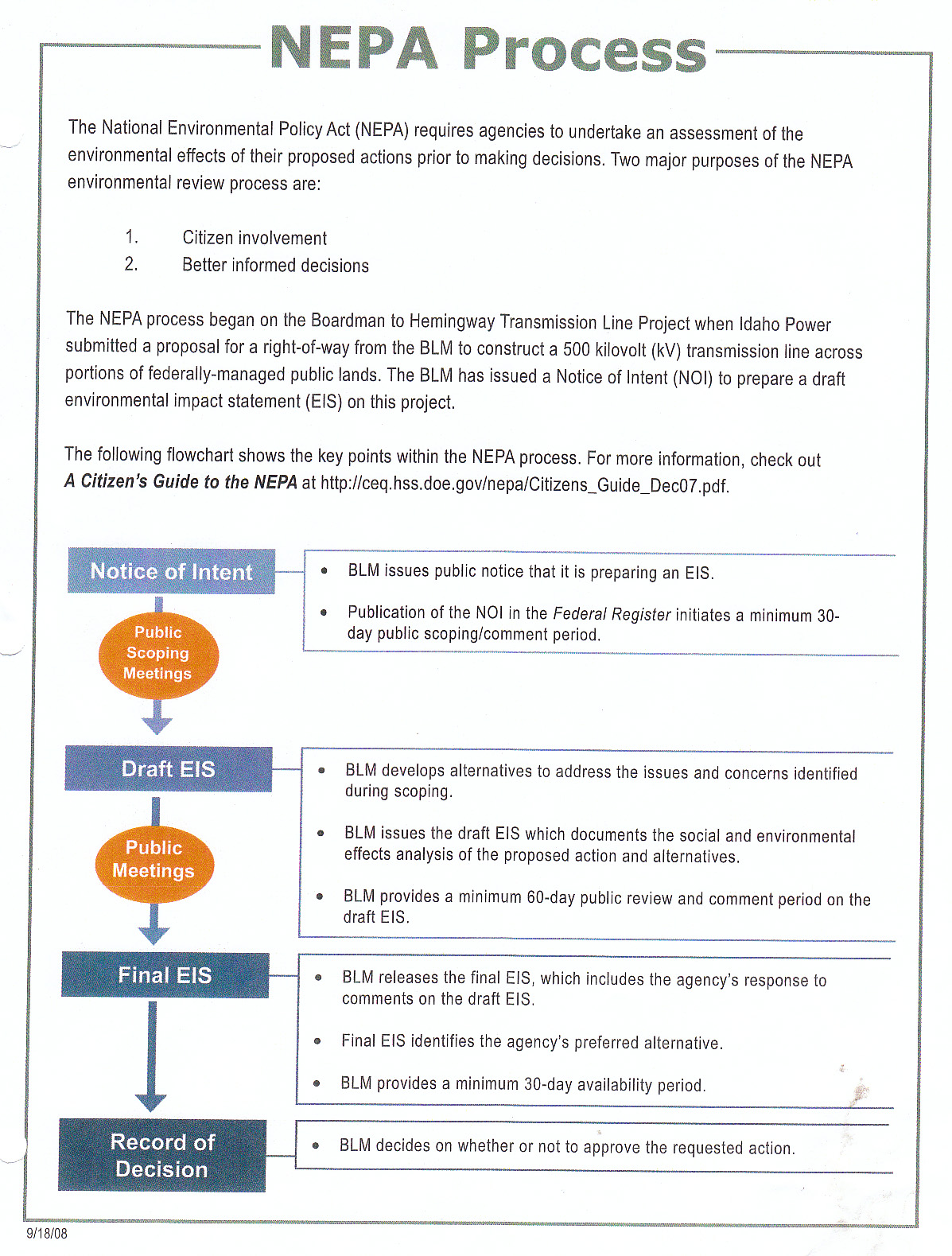
Kent McCarthy, Idaho Power, said the next steps will be to restart the National Environmental Policy Act process, in which the Bureau of Land Management, along with other natural resource agencies, will produce an Environmental Impact Statement and a decision on where it will or will not approve the requested action.

The power company also plans to restart the state process before the Energy Facility Siting Council. Both actions are still expected to come this spring, with the full schedule of public hearings and interim actions by the agencies before final decisions are issued.

In its decision-making process the BLM may offer alternatives to what the Idaho Power Co. has proposed.

“It is not just yes or no,” McCarthy said.

However, with the state EFSC process, alternatives are not offered, he said.

“They can only make a decision on the proposed route,” McCarthy said.

A new route would require a new process, he said.

Additionally, local residents who have been involved in the siting process are encouraged to continue their participation, because there are still opportunities to offer alternatives to the proposed route or for agencies to disapprove of the proposed route.

“There is opportunity to submit alternate routes through the scoping process,” McCarthy said.

He warned that it is important that people follow all the way through, because if the state contests the case hearing, held before the Oregon Department of Energy, and makes the final decision, people wanting to testify must have made comment on the draft. None of the official public hearings are expected until later this summer or fall.

“We’re trying to line the process up,” McCarthy said, so there will be joint meeting and hearings.

Wednesday, April 28, 2010

Commissioners reach decision on land-use plans

http://argusobserver.com/articles/2010/04/27/news/doc4bd71b671abbd799313482.txt
By Brandi Stromberg 4/27/2010

PAYETTE — The Payette County Commissioners approved a comprehensive plan map amendment Monday morning for Alternate Energy Holdings Inc., allowing the company to pursue the construction of a proposed nuclear power-generating plant near Big Willow and Stone Quarry Road in rural Payette County.

“Decisions like these are ones that weigh on our minds for weeks, as I am sure it has for everyone else,” Commissioner Larry Church said. “I think we did a pretty good job on the Comp plan, but some thought we needed textual changes in it.”

Church, along with commissioners Marc Shigeta and Rudy Endrikat, approved the text changes to the county’s Comprehensive plan. Church continued with the decision about the Comprehensive plan amendment for the proposed nuclear plant, saying this was a tough decision for the commission.

“This was supposed to be a land-use issue, we thought about it all the time. This isn’t specifically about the business, although it’s been difficult to get out of our heads,” Church said. “We had to ask ourselves some questions, is this the best place for this industry, is this good for the county, is this going to be the proper and adequate use of the land?”

Church continued, saying the plant was proposed to be in the middle of, basically, nowhere in the dry hills, which is ideal for this kind of plant.

“The negative affects, can and will be fixed,” Church said. “The positive affects are it’s in a very secluded area that is large enough for this type of industry.”

. . . The commissioners unanimously approved the comprehensive plan amendment for the nuclear power plant, the next step will be for the county to consider a rezone, which will be brought to commissioners by the company.

Tuesday, April 27, 2010

New FERC rules tied to climate bill

4/26/2010 http://www.eenews.net/ by subscription only

The Federal Energy Regulatory Commission is striving to propose rules this year that would dictate how power lines are financed and pricing is set for nontraditional grid resources, the agency's chief said yesterday . . .

Now the agency is ready to provide more certainty and send the right signals to those who would build transmission and increase nontraditional or "demand-side" resources, including flywheel and battery storage. The agency aims to voluntarily reduce power consumption using demand response, Wellinghoff said. . .

Wellinghoff said he has ordered FERC staff to draft a proposed rule soon on transmission funding formulas known as cost allocation. . .

"We ought to look at benefits to the entities that the costs are spread to," he said. "We should not spread costs to someone that there is absolutely no benefits to."

FERC already proposed a rule about making demand-side resources equal in market value to traditional power supply, and Wellinghoff said he is hoping to examine the pricing
structure for other non-traditional supply soon.

While FERC has "wide authority" on cost allocation issues, he said it would be easier to defend that authority in court if provisions that explicitly provide it in a bill passed by the Senate Energy and Natural Resources Committee last June were enacted.

Along with cost allocation, the Senate energy bill provides FERC with expanded authority for transmission planning and siting.

But there are questions about whether that bill will pass this year. It's embroiled with a larger, election-year debate on a sweeping Senate climate bill.

Given that, Wellinghoff said his legislative priority is to urge Congress to enact a provision giving FERC "backstop" authority to site transmission and pass a bill to give FERC emergency authority in case of a cyber attack. . .

Opposition from states, utilities

There is significant pushback from states and utilities on the Senate bill's proposed FERC authority. They cite concerns about paying for long power lines bringing Midwestern renewable energy to the East Coast and pre-empting regional planning efforts. . .

As FERC, Congress and the states work out these problems, a transmission problem looms over who will build transmission lines -- traditional utilities, companies that originally proposed the lines, or third parties? -- and how such matters will be decided, Wellinghoff said. . .

TRANSMISSION: $1B Mont.-Idaho proposal delayed again amid county, landowner resistance

http://www.eenews.net/ (subscription only) 4/22/1020 by Phil Taylor

The Bureau of Land Management has for a second time postponed its draft
environmental review of a 430-mile transmission line proposed for Montana and Idaho that has drawn sharp resistance from ranchers and some county commissions.

The $1 billion Mountain States Transmission Intertie project by South Dakota-based NorthWestern Energy would carry up to 1,500 megawatts of renewable wind power from central Montana to markets in the Pacific Northwest and desert Southwest. . .

The city-county council last month sent a letter to BLM and the Montana Department of Environmental Quality urging the agencies to consider routing the line over public lands rather than on private ranches, many of which already contain transmission lines. . .

A recurring theme

The project is the latest transmission proposal in the West to experience blowback over real or perceived threats to resources including property rights, scenic vistas, national security and wildlife. . .

NorthWestern Energy said it is working with state and federal agencies to identify alternative routes along public lands that will be included in the draft environmental impact statement (EIS), which is expected to be re leased in early June, having missed initial deadlines set for last fall and April 2010.

The company's priority, however, is to minimize environmental harm by following existing transmission corridors, said NorthWestern spokeswoman Claudia Rapkoch.

"We're disappointed with the delay," she added. But "we also understand it takes time to work through all these different issues."

Alternative routes and local routing options will be evaluated in the draft EIS, as well as a "no action" alternative, BLM said. A preliminary agency-preferred alternative will be identified in the document.

"We've worked very hard to work out those issues and move the lines off private lands to public lands where we could," said Mackiewicz.

The agency and MDEQ have received more than 100 written comments on the project from state, county and tribal governments and the public, Mackiewicz said.

Bingaman Bill Would Strengthen Energy Efficiency Standards for Appliances

http://www.bignews.biz/?id=848334&keys=Senator-Jeff-Bingaman-EnergyEfficientAppliances
3-5-2010

U.S. Senator Jeff Bingaman, chairman of the Senate Energy and Natural Resources Committee, has introduced bipartisan legislation that would lead to the manufacture and use of more energy efficient everyday appliances. The measure is cosponsored by Senator Lisa Murkowski (R-AK), the committee's ranking member.

The bill aims to strengthen a 20-year Department of Energy's (DOE) initiative that establishes, updates and administers energy efficiency standards for over 33 consumer products – everything from dishwashers to ceiling fans. The initiative has led to the use of more efficient appliances, and in the process save consumers money, strengthen the economy, and reduce greenhouse gases. It is estimated that by 2020 the DOE initiative will reduce national electricity demand at least 15 percent below what it otherwise would have been.

But Bingaman would like to take additional steps to reduce energy consumption. His National Energy Efficiency Enhancement Act of 2010 would lead to more energy efficient furnaces, air conditioners, heat pumps and street lights – four appliances that consume a significant amount of energy each day. The bill implements improved energy efficiency standards negotiated agreements by energy efficiency advocates and appliance manufacturers.

"Greater energy efficiency strengthens our economy, enhances our security, saves consumers money, creates jobs and reduces greenhouse gas pollution. No single program or policy is going to completely end our nation's waste of energy or its carbon emissions, but increased energy efficiency through cost-effective energy standards for appliances and consumer products remains the single most-powerful tool for meeting these goals," Bingaman said.

Bingaman's bill would also change some of the ways the Secretary of Energy administers the program. For example, there would be changes to the criteria the Secretary uses to set efficiency standards in order to include the impact of the new or updated standards on average energy prices, and on the use of new smart grid technology.

The bill builds on Bingaman's American Clean Energy Leadership Act of 2009 (ACELA), which was approved by the Energy Committee last summer and awaits full Senate action. Additional savings from this new bill are estimated at 260 trillion btus of energy by 2020 – the equivalent of about 45 million barrels of crude oil. It is also estimated that the new bill will reduce carbon dioxide emissions by 14.7 million metric tons.

Thursday, April 22, 2010

PUC Comments

For those interested, I have uploaded comment documents for the April 20th OPUC meeting. I will add others as I get them.

Wednesday, April 21, 2010

A Big Thank You

First of all, a big THANK YOU to everyone who showed up to listen at the Public Utilities Commission Hearing for Need. If you weren't able to hear, Gary Pearson got everyone's point across in a booming voice. Thanks for being there!!

Gary Pearson gives his comments to the ALJ at Tuesday night's OPUC Hearing for Need

From our hard-working Stop Idaho Power chair Roger Findley:

I just want to take this opportunity to say a big THANK YOU to all who participated at tonight's big PUC meeting. We packed the room out. PUC estimated there were at least 175 people present. They had to bring in more chairs. The presenters did a spectacular job (as usual). The presentations were polished and right on point. We can not worry about what the outcome will be....we did our part...we hope the process works!

A quote from an Idaho region National Trust official:

"The Stop Idaho Power group had a compelling, orchestrated series of speakers systematically taking on the issues of concern to the OPUC. It will be interesting to see how this plays out."

And a thank you to the Oregon Public Utilities Commission officials and Administrative Law Judge Sarah Wallace for coming all the way to Ontario to listen to our comments.

Monday, April 19, 2010

Oregon PUC at the FRCC Tuesday, April 20th

Idaho Power December 2009 Integrated Resource Plan (IRP)

The Commission is reviewing Idaho Power’s new Integrated Resource Plan (IRP).

Utilities regulated by the Commission must file IRPs every two years. The plan identifies projected growth and what resources the utility wants in order to serve its customers. One element of Idaho Power’s IRP is a proposal for a new transmission line.

If a new route is approved by the Oregon Energy Facility Siting Council the Commission may also be asked to issue a Certificate of Public Convenience and Necessity (CPCN) for the construction of overhead transmission lines.

A CPCN would permit land to be condemned as a last recourse to complete the transmission project.

If Idaho Power makes this request, the OPUC will issue notices and hold public hearings.

All pertinent filing documents can be viewed at : http://apps.puc.state.or.us/edockets/docket.asp?DocketID=15980

You may mail written comments to the Commission at:

Attn.: LC 50
Administrative Hearings Division
Public Utility Commission of Oregon
P.O. Box 2148
Salem, OR 97308-2148

or

Make a comment online through this link: http://apps.puc.state.or.us/commentLC50/message.htm


To all parties in LC 50:

We have recently received some inquiries about the process for the April 20 public comment hearing in Ontario, Oregon. The hearing will start at 5:30 p.m. People will be asked to sign in if they wish to comment on the record, and I will call them up to the microphone to comment. I will be there to listen to comments and to answer questions, and so will representatives from Commission Staff and Idaho Power Company. A court reporter will also be there to transcribe comments for the record.

People do not need to arrive by 5:30 p.m. in order to comment. A sign-up sheet will remain by the entrance until 8:30 p.m. so people can sign in as they arrive. People will not, however, be permitted to sign in after 8:30 p.m. The hearing will continue until all those who sign in before 8:30 p.m. have commented. There will also be comment cards available to submit written comments. In addition, the Commission is setting up a link on its website for people to submit comments electronically. All comments will be part of the official record in the docket.

Please contact me with any questions.

Thank you,

Sarah Wallace

Administrative Law Judge

Tuesday, April 13, 2010

Idaho Power-Pacificorp MOU

http://www.idahopower.com/NewsCommunity/News/mediaCenter/NewsReleases/showPR.cfm?prID=2361

BOISE, Idaho and Portland, Ore. Wednesday, March 31, 2010--- Idaho Power and PacifiCorp today announced their companies have signed a Memorandum of Understanding (MOU) to review potential partnership opportunities in providing essential electricity transmission to customers in the region. The two utilities already are working together on a segment of the proposed Gateway West Transmission Line between Downey, Idaho and the new Hemingway substation, located southwest of Boise. This new MOU will open discussions relating to the termination of certain existing agreements between the utilities to be replaced by joint ownership transmission arrangements and also the joint development, construction and ownership of new transmission projects associated with portions of the proposed Gateway West Transmission Line located in Idaho, and Idaho Power’s proposed transmission line between Hemingway substation and Boardman, Oregon. Though non-binding, the MOU reflects both companies’ commitment to reaching agreements on these matters, to the benefit of customers. The MOU enables strategic discussions between the companies with the purpose of more efficiently utilizing the existing transmission system and potential partnership on new projects to preserve the companies’ rights on behalf of, and for the benefit of, their native load customers and to satisfy their capacity expansion responsibilities under their respective Open Access Transmission Tariffs. Subsequent definitive agreements reached by the companies will be subject to applicable state and federal regulatory approvals. Additional information is available at www.idahopower.com or www.pacificorp.com by searching “OASIS”. Both companies anticipate finalizing these discussions with agreements by fall 2010.

Friday, April 9, 2010

Notice of Public Comment Hearing

The following public notice is the Hearing for Need for the Oregon Public Utility Commission to make a decision on whether the Boardman to Hemingway power line is needed, in conjunction with its 2009 Integrated Resource Plan. If Need is granted to Idaho Power, then the OPUC can assign it the right to condemn property for the purposes of the utility.

ORS 758.015 Certificate of public convenience and necessity. http://www.leg.state.or.us/ors/758.html
(1) When any person, as defined in ORS 758.400, providing electric utility service, as defined in ORS 758.400,
or any transmission company, proposes to construct an overhead transmission line which will necessitate a condemnation of land or an interest therein, it shall petition the Public Utility Commission for a certificate of public convenience and necessity setting forth a detailed description and the purpose of the proposed transmission line, the estimated cost, the route to be followed, the availability of alternate routes, a description of other transmission lines connecting the same areas, and such other information in such form as the commission may reasonably require in determining the public convenience and necessity.

(2) The commission shall give notice and hold a public hearing on such petition. The commission, in addition to considering facts presented at such hearing, shall make the commission’s own investigation to determine the necessity, safety, practicability and justification in the public interest for the proposed transmission line and shall enter an order accordingly. The order shall be subject to review as in other cases. In any proceeding for condemnation, a certified copy of such order shall be conclusive evidence that the transmission line for which the land is required is a public use and necessary for public convenience.


*******************

The Public Utility Commission of Oregon will hold a public comment hearing in Ontario, Oregon to provide an opportunity for the public to comment or ask questions regarding Idaho Power Company's application for approval of its 2009 Integrated Resource Plan (IRP, including the B2H 500 kV power line) as follows:

DATE: Tuesday, April 20, 2010
TIME: 5:30 p.m.-8:30 p.m.
PLACE: Four Rivers Cultural Center, Owyhee River Room, 676 SW 5th Ave, Ontario, OR 97914
ADMINISTRATIVE LAW JUDGE: Sarah K. Wallace

You are invited to attend anytime from 5:30 p.m. to 8:30 p.m. to learn more about the Commission's review of Idaho Power's application. Members of the Commission Staff, Idaho Power, and customer groups (including SIP and MIP) will be available to answer questions from the public during this time.

A court reporter will be present to record comments. If you are unable to attend in person, written comments may be mailed to the Commission at:

Attn: LC 50
Public Utility Commission
P.O. Box 2148
Salem, OR 97308-2148

For more information contact the Commission's Consumer Services Division at 1-800-522-2404.

Wednesday, April 7, 2010

Power corridor will spare Grant County, Ontario under new plan

By Richard Cockle, 4/6/2010 The Oregonian
http://www.oregonlive.com/news/index.ssf/2010/04/power_corridor_will_spare_gran.html

LA GRANDE -- A power company's preferred route for a 299-mile "big extension cord" power line through eastern Oregon to Idaho will bypass both Grant County and a prosperous onion-growing area near Ontario -- both hotbeds of opposition to the project.

Boise-based Idaho Power Co. unveiled its recommended route Tuesday for a 500-kilovolt line. The Hemingway Power Transmission Project would start near Boardman and wind through Morrow, Umatilla, Union, Baker and Malheur counties before ending at the company's Hemingway Substation near Melba, Idaho.

Oregon residents fought two earlier proposals, one that would have taken the line through scenic Grant County mountain and high-desert panoramas, and another that would have removed 1,500 acres of farmland from production near Ontario.

The project became doubly unpopular in Grant County after word got out that company workers went to a John Day pub after a March 2 public meeting and made fun of locals' objections and manner of speaking. The workers also said land would be seized through eminent domain. Company officials apologized and assured residents the workers had been removed from the project.

"It didn't go over at all well," said Mark Webb, chairman of the Grant County commissioners.

Residents, already up in arms over a threat by a group calling itself the Aryan Nations to build a national headquarters in John Day, declared: Neo-Nazis aren't welcome, and neither is the transmission project.

Idaho Power has said the line -- the first big power corridor proposed in Oregon in more than 20 years -- is needed, citing a U.S. Department of Energy report that says U.S. demand for electricity is likely to grow 40 percent in the next two decades. The construction of wind turbines across Oregon is expected to add to the need.

Idaho Power will submit its preferred route to the U.S. Forest Service and U.S. Bureau of Land Management on April 15, said BLM spokesman John Styduhar. The Oregon Energy Facility Siting Council and Public Utility Commission also must approve the route.

Idaho Power originally hoped to begin building the corridor next year and have electricity coursing through by June 2013. Spokeswoman Piper Hyman said the company remains on schedule.

Styduhar, however, suggested that the project may run past the deadline. "I would say on a fast track it would take 1 1/2 to 2 years" to win approval, he said. "This is not a fast-track project."